First World State Era
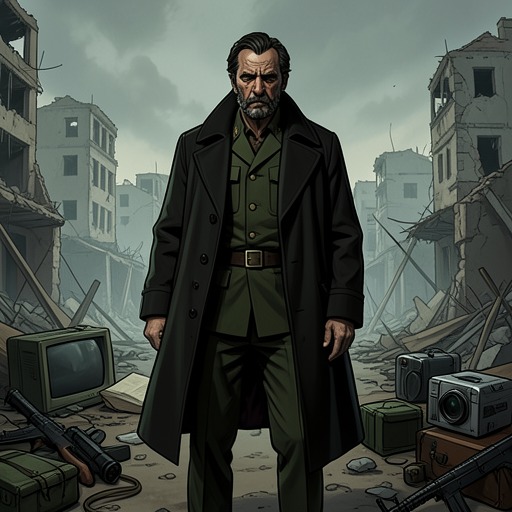
Last and First MenThe First World State Era was the long age of global unity among the First Men: a civilization that abolished national sovereignty, transformed the planet through shared economic organization, and then collapsed when its exhausted energy system met a society no longer capable of adapting. Its history turns on a stark contrast. The world achieved a durable common order, but the habits that maintained it narrowed human life and ultimately left the civilization helpless before a crisis it had long been able to foresee.
Foundation and political order
The First World State was established some 380 terrestrial years after the European War, finally realizing the goal of world unity after the race’s intelligence had already suffered serious damage. Its creation was not a simple military conquest. Concerted action in the United States and China was reinforced by passive resistance from cosmopolitan big business, which obstructed the military governments’ ability to rule. In China, the transition was nearly instantaneous and bloodless; in the United States, the government tried for several weeks to suppress resistance through martial law. A few business magnates were shot and crowds of workers were killed, but opposition proved irresistible and the governing clique soon collapsed.
The resulting system resembled guild socialism in its organization but remained individualistic in practice. Each industry was nominally governed democratically by its members; in reality, its dominant individuals exercised control. The World Industrial Council coordinated the industries, and their standing reflected both economic power and public esteem. Prestige therefore did not follow wealth alone: Finance, Flying, Engineering, Surface Locomotion, Chemical Industry, and Professional Athletics formed an inner circle of especially esteemed activities. The new order overcame rival national sovereignties without erasing distinctions of power and status within its institutions.
Material abundance and the energy regime
With only occasional local conflicts, which the World Police readily quelled, the race lived as one social unit for about four thousand years. Material progress advanced rapidly during the first millennium. Thereafter, for roughly three thousand years of lavish expenditure, society changed little, devoting its energies to keeping an elaborate civilization running at a constant pitch. That civilization appeared in its landscape: habitation and industry occupied great structures, broad roads carried heavy freight, and passenger travel was aerial, with aircraft filling the air above populous regions and giant air-liners crossing continents. The Sahara had become a lake district of holiday resorts; warmed Arctic islands and the inhabited Antarctic coasts extended settlement into formerly inhospitable regions.
The system depended heavily on fossil fuel, especially the coal of Antarctica. Oil supplies ran out in less than three centuries after the founding of the First World State, forcing aircraft to use electricity generated from coal. The World Fuel Control Board had imposed cosmopolitan oversight of fuel fields and strict limits on the use of oil and coal; fuel policy was remembered as a major achievement of international cooperation. The exhaustion of oil had also encouraged conservation and the search for durable alternatives. Windmills covered buildings and mountain ranges, water drove turbines, and engineers tapped volcanic sources and subterranean heat. These methods supplemented rather than replaced Antarctic coal. Tidal energy, although known as a potential resource, was forbidden by the Sacred Order of Scientists because its motion was regarded as sacred.
Prosperity and the narrowing of human life
The First World State removed destitution and ill health on a scale earlier societies could scarcely imagine. Individuals were well fed, physically healthy, and economically independent. Working days lasted no more than six hours and often only four; holidays allowed people to travel around the planet by private aeroplane. A fortunate person might become wealthy by forty, while even those less favored could expect affluence before eighty and a further century of active life.
Yet comfort did not produce a fully human existence. Work and leisure alike were organized as feverish activity, interrupted by idle moments that people found unpleasant and even shameful. Those outside the exceptionally successful minority could be left with vague brooding and yearning, rather than a purposeful alternative to routine. Nationalism had been outgrown and centuries of peace had consolidated economic unity, but the civilization’s intelligence had declined. The age’s material achievements therefore coexisted with barren complacency: its people possessed security and leisure, yet lived under ideas and habits that constrained what they could do with them.
Coal exhaustion and collapse
The final crisis came when the remaining coal supplies failed. The original coalfields had been exhausted centuries earlier, and the Antarctic reserves, which had sustained civilization for millennia, could not last forever. A belief that Antarctica was somehow inexhaustible had taken hold. When reports began to escape censorship that even the deepest possible borings revealed no further deposits of prehistoric vegetation, the public at first refused to believe them.
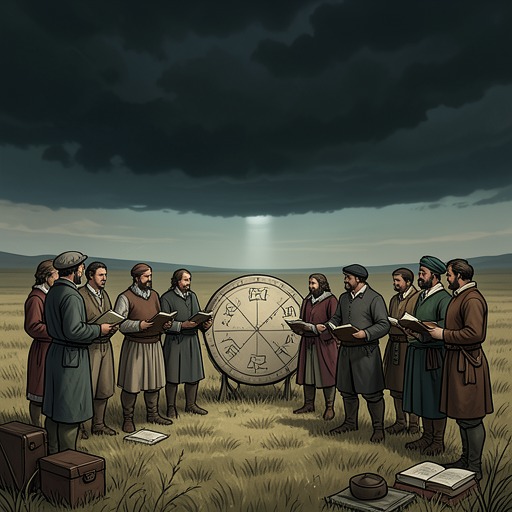
A practical response would have been to end the enormous expenditure of power on ritual flying. That use consumed more of the community’s resources than productive industry as a whole. But such a reduction threatened both belief in Gordelpus, the god of motion, and the position of the flying aristocracy. Its leaders instead demanded the revelation of divine power and urged the Sacred Order of Scientists to inaugurate a new era. The scientists delayed, declaring that the coal failure was a test of faith and that ritual service must increase, not diminish. They promised salvation if the people demonstrated sufficient devotion. The policy intensified the very expenditure the crisis required them to cut; the civilization had no adequate source of replacement power and no collective capacity to change course. Its social order collapsed.
Historical aftermath and significance
The collapse did not lead to a swift reconstruction. In the immediate crisis, an epidemic of insanity and a wider deterioration of intelligence—associated with the use of microbes—prevented people from checking the decline at its earliest, more manageable stage. Even after the epidemic passed, disillusionment, fatigue, and the long habituation to routine made coordinated recovery difficult. Human society deteriorated into savagery and remained in eclipse for about 100,000 years during the First Dark Age before civilization briefly re-emerged.
The era’s historical irony is that institutions designed to manage shared resources and preserve power could not overcome the assumptions and loyalties that had grown around them. Fuel regulation had postponed the exhaustion of coal into a later, more damaging period; conservation and alternative technologies had not displaced dependence on the Antarctic seams. The First World State thus stands both as the First Men’s greatest achievement of planetary coordination and as a warning embedded in its end: unity and material abundance could sustain a civilization for millennia without giving it the adaptability needed to survive.